10 Best AI Tools Every Content Creator Must Try in 2026. Affiliate marketing is a performance-based strategy where businesses and individuals collaborate to generate revenue. It allows companies to expand their reach and boost sales, while individuals can earn commissions by promoting products or services.
Whether you are a brand aiming to increase conversions or someone looking to build an online income stream, understanding how affiliate marketing works is essential. This guide will help you grasp the concept clearly and show you how to use it effectively.
What is Affiliate Marketing?
- 1 What is Affiliate Marketing?
- 2 How Does Affiliate Marketing Work?
-
3
Benefits and Importance of Affiliate Marketing
- 3.1 Benefits of Affiliate Marketing
- 3.2 Importance of Affiliate Marketing
- 3.3 Conclusion
- 3.4 FAQs
- 3.5 1. What is affiliate marketing in simple words?
- 3.6 2. How does affiliate marketing work?
- 3.7 3. Do I need investment to start affiliate marketing?
- 3.8 4. What are the main benefits of affiliate marketing?
- 3.9 5. Is affiliate marketing a long-term career option?
Affiliate marketing is a performance-based marketing model where businesses (known as merchants or advertisers) partner with individuals or organizations (called affiliates) to promote their products or services. Affiliates use various digital channels—such as blogs, social media, websites, and email marketing—to reach potential customers.
To track performance, advertisers provide affiliates with unique links or codes. These tracking tools help measure clicks, conversions, and overall campaign success.
Key Takeaways:
- Affiliates earn a commission whenever a user clicks on their link and completes a specific action, such as making a purchase, signing up, or downloading an app.
- This commission-based model motivates affiliates to promote products effectively.
- It helps businesses increase website traffic, generate leads, and boost sales while allowing affiliates to earn income online.
How Does Affiliate Marketing Work?
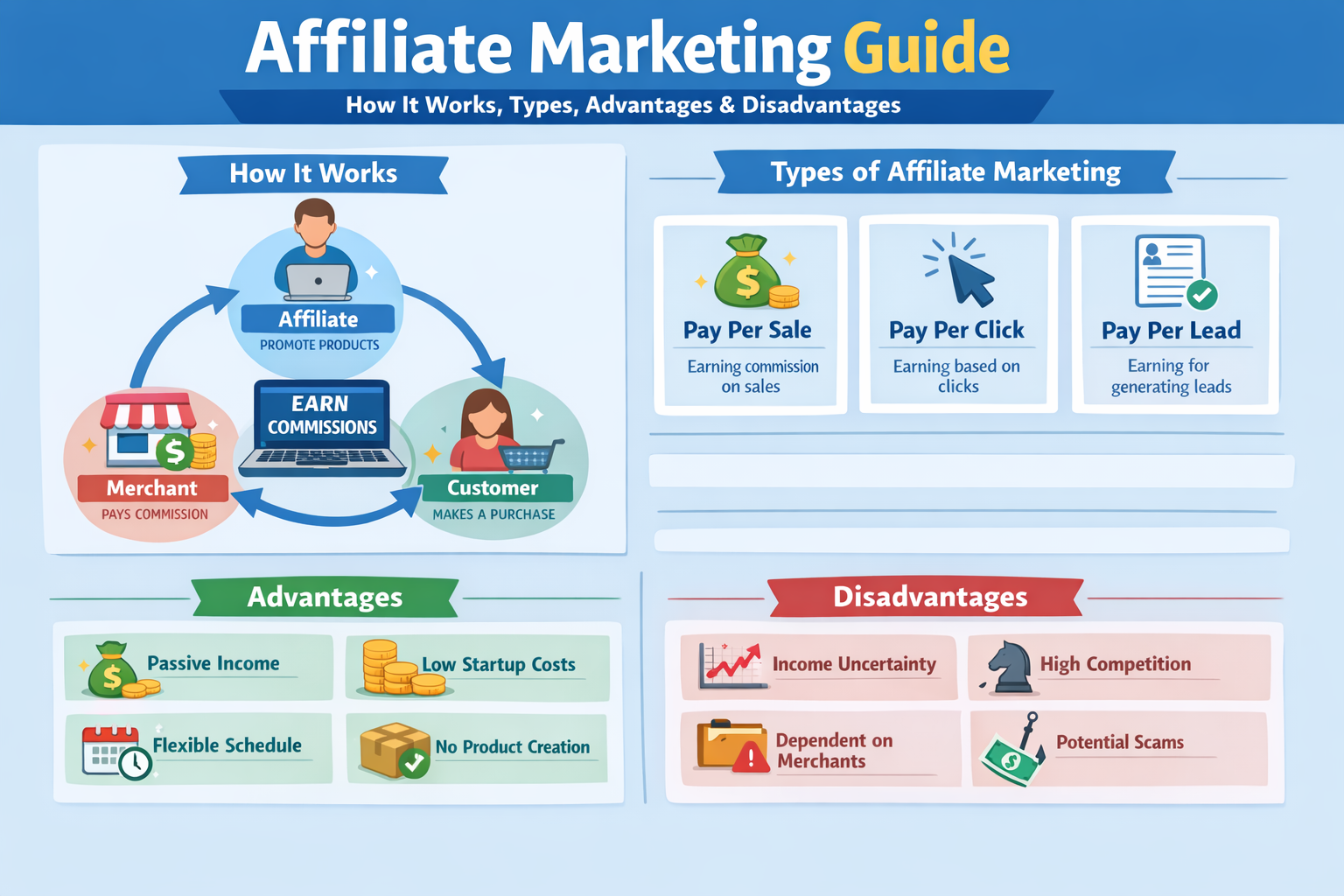
Affiliate marketing is a performance-driven model that connects three key participants: the merchant (advertiser), the affiliate (publisher), and the customer. Here’s a clear and simplified breakdown of the process:
1. Merchant (Advertiser)
The merchant is the business that offers a product or service. They create affiliate programs and provide unique tracking links or codes to affiliates. These links help identify which affiliate generated a sale or lead.
2. Affiliate (Publisher)
The affiliate is an individual or company that promotes the merchant’s products. They use channels like websites, blogs, social media, email campaigns, or other digital platforms to share affiliate links and attract potential customers.
3. Customer (Consumer)
Customers discover the product through the affiliate’s content and click on the special tracking link. This action redirects them to the merchant’s website.
4. Conversion
A conversion happens when the customer completes a specific action—such as making a purchase, signing up for a service, or filling out a form—on the merchant’s website.
5. Commission
Once a successful conversion is tracked, the affiliate earns a commission. The payout structure and commission rates vary depending on the agreement between the merchant and the affiliate.
Types of Affiliate Marketing

Affiliate marketing comes in different forms depending on how closely the affiliate is connected to the product and the method used to promote it. Below is a clear and simplified breakdown:
Based on Involvement Level
1. Unattached Affiliate Marketing
In this type, the affiliate has no direct connection with the product or service they promote. They don’t use or endorse it personally.
They simply create content—like blogs, videos, or ads—and share affiliate links. When someone purchases through those links, they earn a commission.
- Related Affiliate Marketing
Here, the affiliate has some connection to or expertise in the product’s niche. They may not have personally used the product, but they have enough knowledge and authority to promote it.
Benefit: Better credibility and audience trust compared to unattached marketing.
- Involved Affiliate Marketing
In this model, the affiliate personally uses and believes in the product or service. They promote it based on their real experience and recommendations.
Advantage: High trust and strong influence on audience decisions.
Based on Promotion Methods
- Content-Based Affiliate Marketing
Affiliates create blogs, articles, videos, and reviews that include affiliate links to promote products or services. This method focuses on providing informative and engaging content to attract and convert users.
- Coupon & Deal Websites
Affiliates share discount codes, promotional offers, and special deals through dedicated platforms. The goal is to drive purchases by highlighting cost-saving opportunities.
- Email Marketing
Affiliates build and manage email lists to promote products through newsletters and targeted campaigns. Affiliate links are included within the email content to generate conversions.
- Social Media Affiliate Marketing
Affiliates use platforms such as Instagram, Facebook, and YouTube to promote products through posts, videos, and other content formats. Affiliate links are shared within captions, bios, or descriptions.
- Comparison & Review Websites
Affiliates create detailed product comparisons and reviews within a specific niche. These platforms present structured information to help users evaluate different options.
- Niche-Specific Affiliate Marketing
Affiliates focus on a particular industry or category, creating targeted content related to that niche. This approach involves promoting products that align with a specific audience segment.
- Software & App Promotion
Affiliates promote digital products such as software tools and mobile applications. Content includes tutorials, guides, and detailed explanations integrated with affiliate links.
- Multi-Tier Affiliate Marketing
Affiliates refer other affiliates to join the program and earn commissions based on both their own performance and the activities of their referrals.
- Lead Generation Affiliate Marketing
Affiliates focus on generating leads by encouraging users to complete actions such as form submissions, registrations, or inquiries. Earnings are based on lead acquisition rather than direct sales.
- PPC & SEM Affiliate Marketing
Affiliates use paid advertising strategies on search engines and social media platforms to promote products. Traffic is directed to affiliate offers through targeted ads containing affiliate links.
Read Also:- 10 Best AI Tools Every Content Creator Must Try in 2025
Benefits and Importance of Affiliate Marketing
Affiliate marketing offers advantages for both advertisers and affiliates, which is why it has become a widely adopted digital marketing strategy.
Benefits of Affiliate Marketing
Affiliate marketing involves minimal financial risk for advertisers, as payment is only made when a successful conversion occurs. This makes it a performance-based and cost-controlled approach.
It also provides flexibility for advertisers, allowing them to scale their affiliate network up or down based on business needs without long-term commitments or fixed costs.
For affiliates, the model offers freedom and flexibility. There are no fixed working hours or restrictions on promoting multiple products. Affiliates can manage it alongside other professional activities and even use it as a source of additional income.
From a business perspective, affiliate marketing requires relatively low initial investment compared to traditional marketing methods, making it accessible for startups and small businesses.
Since affiliates often promote products to relevant audiences, the traffic generated is usually targeted and more likely to align with user interest.
Importance of Affiliate Marketing
Affiliate marketing plays a key role in expanding business reach and improving overall sales performance by connecting brands with a wider audience.
It also helps in increasing brand visibility, as affiliates promote not only products but also the brand itself across different platforms.
In addition, affiliate marketing can contribute to improved SEO performance, as backlinks from affiliate websites can enhance search engine visibility and organic rankings of a business website.
Conclusion
Marketing methods have evolved significantly over time, and affiliate marketing has emerged as one of the most effective digital strategies. Understanding and applying modern marketing techniques is essential in today’s competitive environment, where digital platforms continue to shape business growth and customer engagement.
FAQs
1. What is affiliate marketing in simple words?
Affiliate marketing is a performance-based method where individuals earn a commission by promoting a company’s products or services using special tracking links.
2. How does affiliate marketing work?
Affiliate marketing works through three main parties: the merchant (product owner), the affiliate (promoter), and the customer. The affiliate shares a tracking link, and when a customer completes an action like buying or signing up, the affiliate earns a commission.
3. Do I need investment to start affiliate marketing?
No, most affiliate programs are free to join. However, investment may be required for building a website, running ads, or creating content for better results.
4. What are the main benefits of affiliate marketing?
It allows earning income without creating a product, offers flexible working conditions, and helps businesses reach a larger audience while paying only for results.
5. Is affiliate marketing a long-term career option?
Yes, affiliate marketing can be a long-term income source if done with consistent content creation, proper strategy, and audience trust-building over time.
For expert insights on branding and business strategy, visit Manjeet Madhukar’s official website.