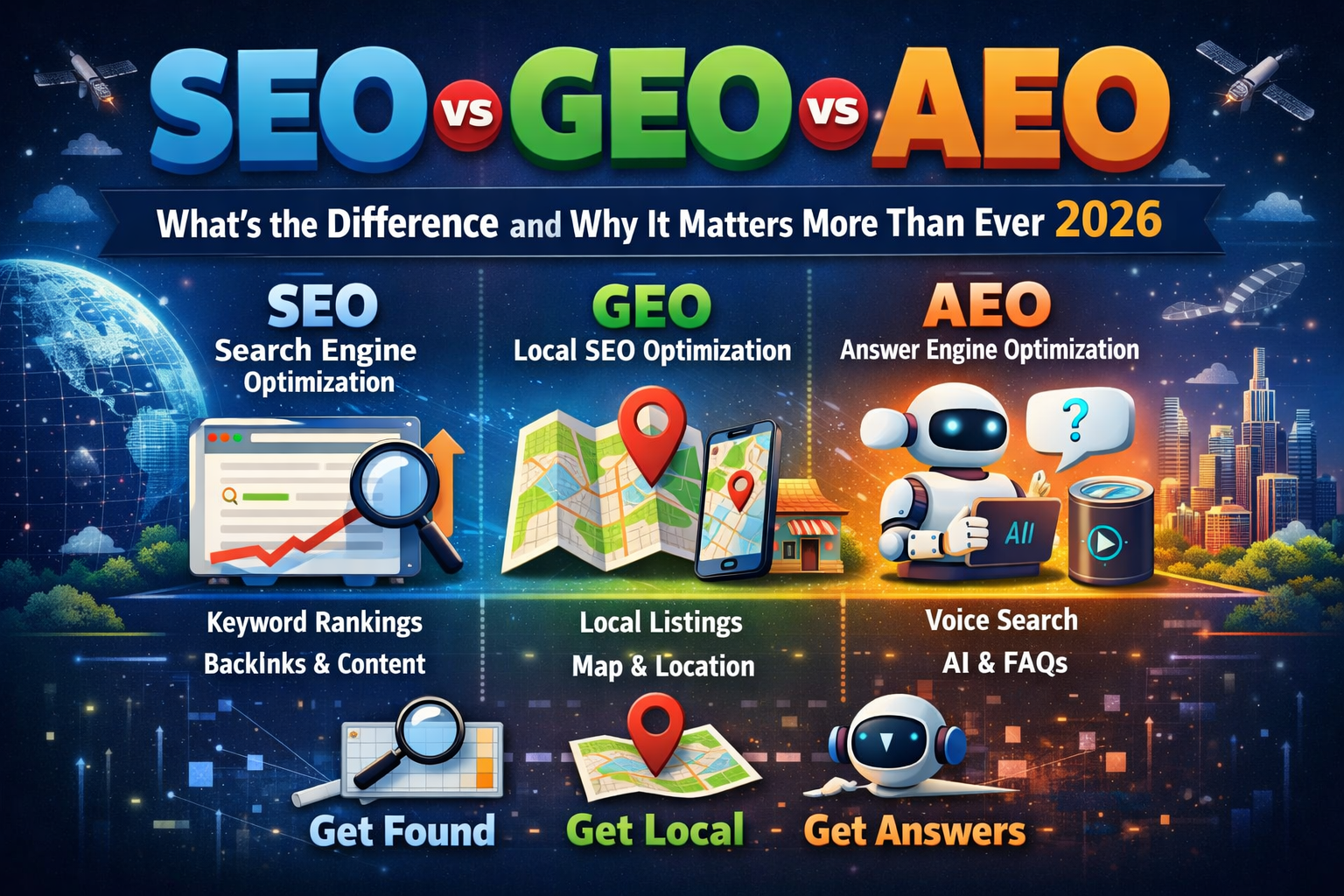
The difference between SEO GEO and AEO. If you’ve spent any time in the world of digital marketing, you’ve probably heard three terms being used everywhere: SEO, GEO, and AEO. They may sound similar—and yes, they are connected—but each one plays a unique role in how your business gets discovered online. Understanding these differences isn’t just helpful anymore—it’s essential.
Because here’s the truth: if your strategy still relies only on traditional SEO, you’re already falling behind.
Search is evolving rapidly. With the rise of AI-driven platforms, businesses now need to optimize not just for search engines, but also for answer engines (AEO) and generative engines (GEO). Ignoring this shift means missing out on visibility where your audience is actually searching today.
In this blog, we’ll simplify these concepts, explore how they differ, and give you practical insights to stay ahead in the future of search.
Types of Search Optimization Strategies
- 1 Types of Search Optimization Strategies
- 2 Answer Engine Optimization (AEO)
- 3 Generative Engine Optimization (GEO)
- 4 GEO vs. AEO vs. SEO: What’s the Real Difference?
- 5 Actionable Tips to Optimize AEO & GEO for AI Search Visibility
- 6 Keyword Research Strategy
- 7 Content Structuring
- 8 Technical Enhancements
1. Search Engine Optimization (SEO)
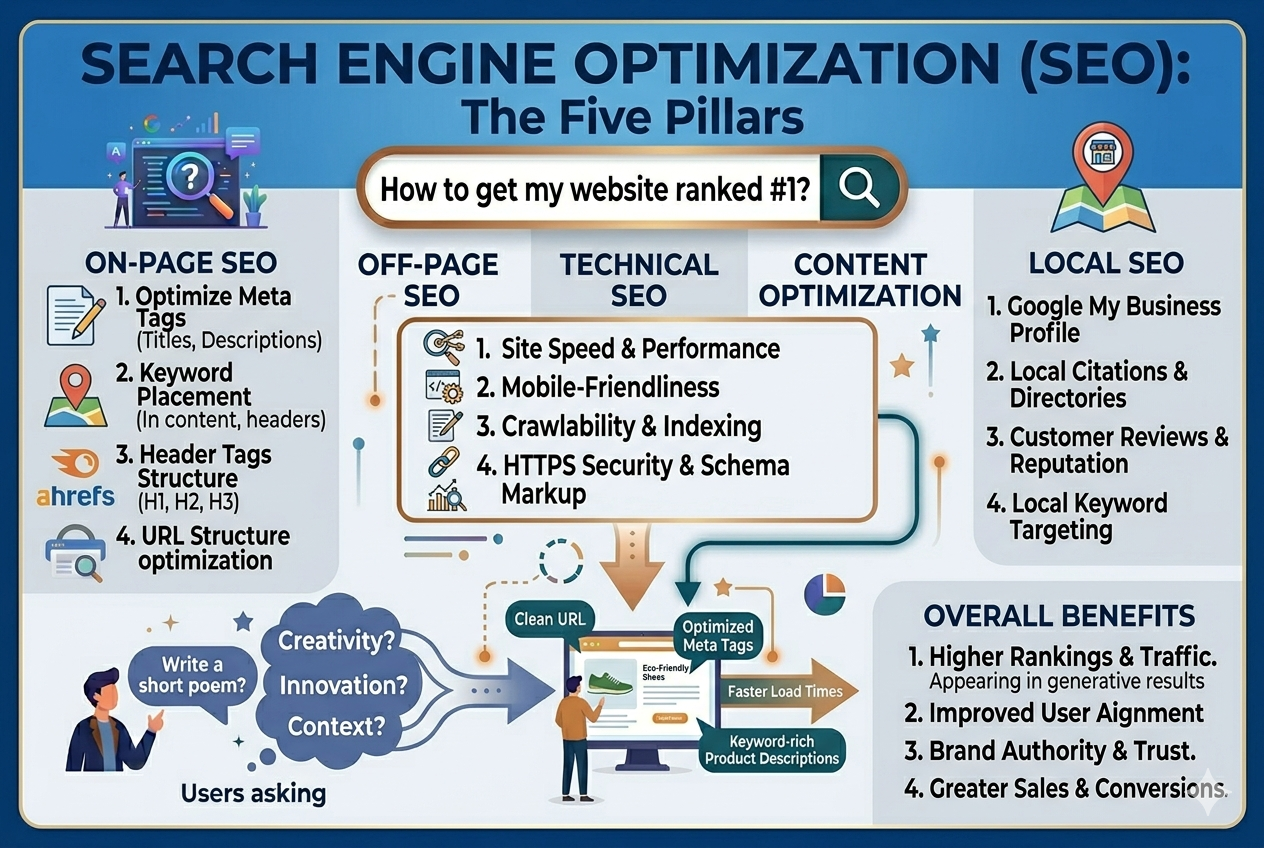
What is SEO?
SEO (Search Engine Optimization) is the practice of improving your website’s visibility on traditional search engines like Google and Bing. The main objective is to rank higher in search results, drive organic traffic, and attract the right audience to your website.
How SEO Works
A strong SEO strategy is built on several key pillars:
- On-Page SEO
This involves optimizing your website content—titles, headings, and keywords—to match what users are searching for. A well-structured page helps search engines understand your content better and improves your chances of ranking higher.
- Off-Page SEO
Off-page SEO focuses on building your website’s authority through backlinks from other trusted websites. The more high-quality links you earn, the more credible your site appears to search engines. - Technical SEO
This ensures your website runs smoothly. Fast loading speed, mobile-friendly design, and error-free navigation all contribute to better indexing and improved user experience. - Local SEO
For businesses targeting specific areas, local SEO is crucial. Using location-based keywords and keeping your Google Business Profile updated helps you appear in local search results and attract nearby customers. - Content Optimization
At the heart of SEO is content. Creating valuable, user-focused content that answers real questions improves engagement and increases your chances of ranking for relevant keywords.
A well-planned SEO strategy not only boosts your website’s visibility but also drives consistent, long-term growth by connecting you with the right audience at the right time.
Answer Engine Optimization (AEO)
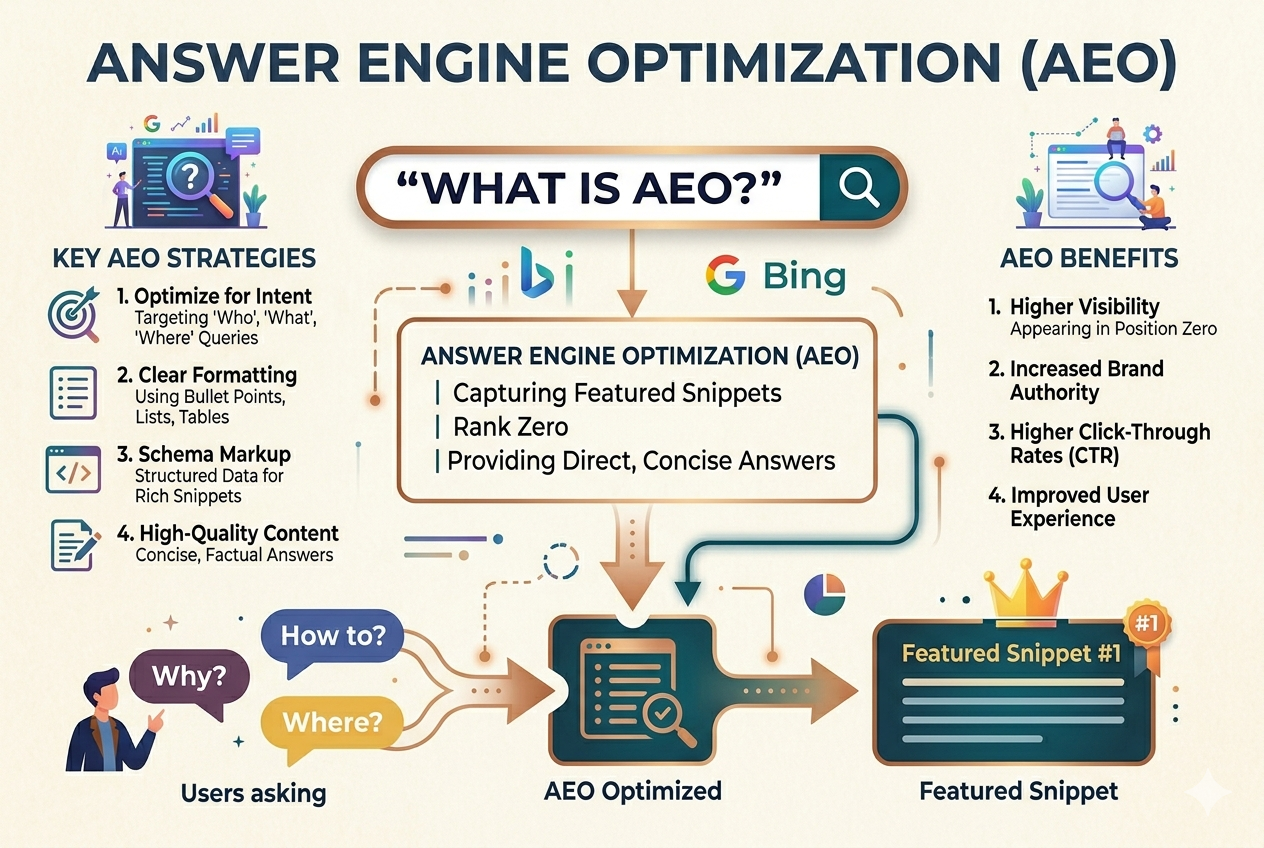
What is AEO?
Answer Engine Optimization (AEO) is all about preparing your content so that search engines and AI-powered assistants can instantly deliver it as a direct answer to users. Instead of simply ranking web pages like traditional SEO, AEO focuses on making your content easily extractable for features like featured snippets, knowledge panels, and voice search results.
Today’s users don’t want to scroll through multiple links—they want quick, accurate answers. AEO helps your content become that answer, increasing your chances of appearing right at the top, often without the user needing to click through to a website.
How AEO Works
A successful AEO strategy focuses on structuring content in a way that AI systems can easily understand and present:
- Featured Snippet Optimization
Content is formatted into clear lists, short paragraphs, and tables so search engines can quickly pick and display the most relevant information. This increases your chances of securing the coveted “position zero” in search results. - Voice Search Optimization
AEO aligns your content with how people actually speak. By using conversational language, long-tail keywords, and question-based headings, your content becomes more suitable for voice assistants like Siri, Alexa, and Google Assistant. - Schema Markup Implementation:
Schema markup is a behind-the-scenes code that helps search engines better understand your content. By tagging elements like FAQs, reviews, and events, you make it easier for search engines to display your information in rich results, boosting visibility and engagement.
With the rapid growth of voice search and AI-driven queries, AEO is no longer optional—it’s becoming a necessity. As more users rely on instant answers, businesses that optimize for AEO will gain a significant advantage, while those who don’t risk losing visibility to more adaptable competitors.
Generative Engine Optimization (GEO)

What is GEO?
Generative Engine Optimization (GEO) focuses on optimizing your content for AI-driven search platforms that generate direct answers instead of simply listing web pages. Platforms like ChatGPT, Google Gemini, and Perplexity analyze and combine information from multiple sources to deliver complete, conversational responses.
Unlike traditional SEO, where ranking on a search results page is the goal, GEO is about becoming part of the answer itself. When your content is well-structured and context-rich, it increases the chances of being picked up and referenced in AI-generated responses—boosting both visibility and authority.
How GEO Works
To succeed with GEO, your content needs to align with how AI systems process and present information:
- AI-Friendly Content
Content should be clearly structured with proper headings, logical flow, and well-organized information. Providing detailed, context-rich explanations helps AI models better understand and extract relevant insights. - Conversational Tone
Writing in a natural, human-like style is key. Since users interact with AI using conversational queries, content that mirrors this tone is more likely to be selected and presented in responses. - E-E-A-T Compliance
Content must demonstrate strong signals of experience, expertise, authoritativeness, and trustworthiness. AI systems prioritize credible, high-quality information from reliable sources when generating answers.
As AI-powered search continues to evolve, GEO is becoming a critical part of digital visibility. Businesses that adapt their content for generative engines will not only improve their reach but also position themselves as trusted sources in the age of AI-driven search.
GEO vs. AEO vs. SEO: What’s the Real Difference?
When optimizing your content, you’re not just choosing between SEO, AEO, or GEO. Each approach plays a unique role at different stages of the search journey. The real advantage comes from combining them strategically—rather than relying on just one—to maximize your visibility and results.
| Feature | SEO (Search Engine Optimization) | AEO (Answer Engine Optimization) | GEO (Generative Engine Optimization |
| Core Goal | Rank in search results | Provide fast, direct answers | Be referenced in AI-generated summaries |
| Primary Platforms | Google & Bing search results | Featured snippets, voice assistants, and AI Overviews | ChatGPT, Perplexity, Claude, SGE |
| Success Metrics | Rankings and organic traffic | Inclusion in snippets, SERP, or answer boxes | Branded citations in AI-generated content |
| How Users Search | Keyword-based queries | Short, intent-driven questions | Conversational, complete questions |
| Key Tactics | On-page SEO, technical SEO, and UX | Schema mark-up, FAQ optimization | Digital PR (Backlinks), conversational phrases |
Actionable Tips to Optimize AEO & GEO for AI Search Visibility
Combining AEO (Answer Engine Optimization) and GEO (Generative Engine Optimization) is not about replacing traditional SEO—it’s about improving and expanding it.
You don’t need to leave your current SEO strategy behind or create a completely new one. Instead, making a few focused changes can help your content perform better across search engines, voice assistants, and AI-powered platforms.
Below are three important adjustments that can enhance your search performance:
Read Also:- Professional Local SEO Services to Boost Your Google Rankings
Keyword Research Strategy
AI search ke daur mein behtar visibility ke liye keyword strategy mein badlav karna zaroori hai. Sirf high-volume aur short keywords par nirbhar rehne ke bajaye, in teen pramukh pahluon par kaam karein:
1. Long-Tail and Question-Based Keywords
AI-driven search engines ab conversational queries ko prathmikta dete hain. Isliye, aise phrases ko target karein jo natural aur user-focused hon. Seedhe sawalon ko apne content ka hissa banayein taaki AI models aapke content ko seedhe jawab ke roop mein pehchan saken.
2. SERP Analysis and Featured Snippets
Apne targeted keywords ke liye top-ranking results ka gehra adhyayan karein. Search Engine Results Pages (SERPs) mein maujood “People also ask” section aur featured snippets par dhyan dein. Isse aapko ye samajhne mein madad milegi ki search engines kis tarah ke structure aur jankari ko sabse zyada mahatva de rahe hain.
3. Analytics-Driven Content Refinement
Apni website ke analytics ka istemal karke un search terms ko pehchanein jo visitors ko aapki site tak la rahe hain. Agar user question-based queries ke zariye aa rahe hain, toh apne content ko aur zyada refine karein. Apne data ko is tarah organize aur structure karein ki AI aur search engines unhe asani se scan aur retrieve kar saken.
Content Structuring
Featured snippets, voice search, aur AI responses mein rank karne ke liye content ka structured aur clear hona zaroori hai. AI systems un direct answers ko prathmikta dete hain jo organized hon aur asani se retrieve kiye ja saken.
1. Question-Based Headings ka Istemal
AI algorithms un headings ko behtar samajhte hain jo sawalon ke roop mein hoti hain. H2 aur H3 subheadings ko direct questions ke taur par structure karne se AI ko ye signal milta hai ki aapka content user ki query ka sateek jawab pradan karta hai.
2. Headings ke Neeche Direct Answers
Heading ke turant baad ek sanchipt (concise) aur direct jawab likhein. AI-generated responses aur featured snippets mein chune jane ke liye shuruati 1-2 lines mein main answer dena prabhavi hota hai, jiske baad aap vistar se jankari de sakte hain.
3. Content ko Scannable Banayein
Content ko jaldi padhne layak banane ke liye chhote sentences aur concise paragraphs (adhiktam 2-3 sentences) ka upyog karein. Bullet points aur step-by-step breakdowns ka istemal karke mukhya jankari ko highlight karein taaki AI aur users dono ise asani se samajh saken.
4. FAQ Section Shamil Karein
FAQ sections AI ko user queries ke saath sateek jawab match karne mein madad karte hain. Har sawal user ki real intent ke anusar hona chahiye aur usme faltu text se bachna chahiye. Isse voice search aur AI snippets mein aapke content ke select hone ke chances badh jate hain.
5. Adhering to CSQAF Principles
To enhance credibility and relevance in the eyes of AI engines, utilize the CSQAF framework:
- Citations: Reference credible and high-authority sources to improve the trustworthiness of your claims.
- Statistics: Incorporate relevant data and factual figures to make your content more authoritative and evidence-based.
- Quotations: Include expert insights or industry-leading quotes to boost the reliability and depth of your information.
- Fluency & Readability: Write in a clear, natural, and conversational style to ensure that both AI models and human users can easily comprehend the content.
- Authoritativeness: Establish expertise through well-researched, confident, and comprehensive writing that demonstrates a deep understanding of the subject matter.
Here is the professional English version of the Technical Enhancements section:
Technical Enhancements
For AI search engines to prioritize your content, developers must focus on structured data, clean coding, and performance optimization. These improvements enhance visibility in AI-driven results while ensuring a seamless user experience. Key areas to optimize include:
1. Implement Schema Markup
Structured data helps AI understand the context of your content. Utilize Schema.org markup to define content types such as FAQs, articles, products, and reviews. This significantly increases your chances of being featured in rich results, snippets, and AI-generated responses.
2. Optimize HTML Structure
Streamline your HTML to eliminate redundant code and reduce file sizes. By removing optional closing tags (such as </li> or </p>), you can shrink HTML files by 5-20%, which improves both page speed and crawling efficiency for AI bots.
3. Reduce JavaScript Dependency
Heavy JavaScript usage can slow down page load times and hinder how AI search engines interpret your content. Minimize JavaScript reliance and prioritize CSS for styling whenever possible to enhance overall performance and accessibility.
4. Image Speed Optimization
Adopt modern, lightweight image formats like WebP and implement lazy-loading techniques to ensure images load only when necessary. This reduces initial page load times, boosting both traditional SEO and AI-driven rankings.
5. Enhance CSS and Font Performance
Inline critical CSS to accelerate rendering and minimize the use of custom fonts by limiting variations. Using system fonts where possible helps reduce render-blocking resources, improving performance across both mobile and desktop devices.
By implementing these technical optimizations, websites load faster, rank higher in AI-driven searches, and provide a superior user experience across all devices.
Final Thoughts
The way people search is changing faster than ever. What started with traditional search engines has now evolved into a powerful mix of SEO, AEO, and GEO—each playing a critical role in how your content gets discovered.
Relying only on SEO is no longer enough. While SEO helps you rank, AEO ensures you become the direct answer, and GEO positions your brand within AI-generated conversations. Together, they create a complete search strategy that covers every stage of the modern user journey.
The real opportunity lies in integration, not replacement. Businesses that combine all three approaches will dominate visibility—across search engines, voice assistants, and AI platforms. Those who ignore this shift risk becoming invisible in an increasingly AI-driven digital landscape.
Now is the time to adapt.
Start optimizing your content not just for clicks, but for answers and AI relevance. Focus on clarity, structure, trust, and user intent. Because in 2026 and beyond, the brands that win won’t just rank on search engines—they’ll become the source of answers everywhere.
FAQs
1. What is the main difference between SEO, AEO, and GEO?
SEO focuses on ranking your website in search engine results, AEO aims to provide direct answers for queries (like featured snippets and voice search), and GEO is about optimizing content so it gets included in AI-generated responses from platforms like ChatGPT and Google Gemini.
- Is traditional SEO still important in 2026?
Yes, SEO is still the foundation of online visibility. However, relying only on SEO is not enough anymore. To stay competitive, businesses must combine SEO with AEO and GEO to reach users across search engines, voice assistants, and AI platforms.
- How does AEO help improve search visibility?
AEO improves visibility by making your content easy for search engines and AI assistants to extract as direct answers. This helps you appear in featured snippets, voice search results, and “People Also Ask” sections—often at the top of search results.
- Why is GEO becoming important for AI-driven search?
GEO is important because AI platforms no longer just list websites—they generate complete answers. If your content is optimized for GEO, it increases the chances of being referenced in AI-generated responses, boosting both brand visibility and authority.
- How can I optimize my content for SEO, AEO, and GEO together?
You can combine all three by:
- Using long-tail and question-based keywords
- Structuring content with clear headings and direct answers
- Adding FAQ sections and schema markup
- Writing in a conversational and user-focused tone
- Ensuring your website is fast, mobile-friendly, and technically optimized
For expert insights on branding and business strategy, visit Manjeet Madhukar’s official website.