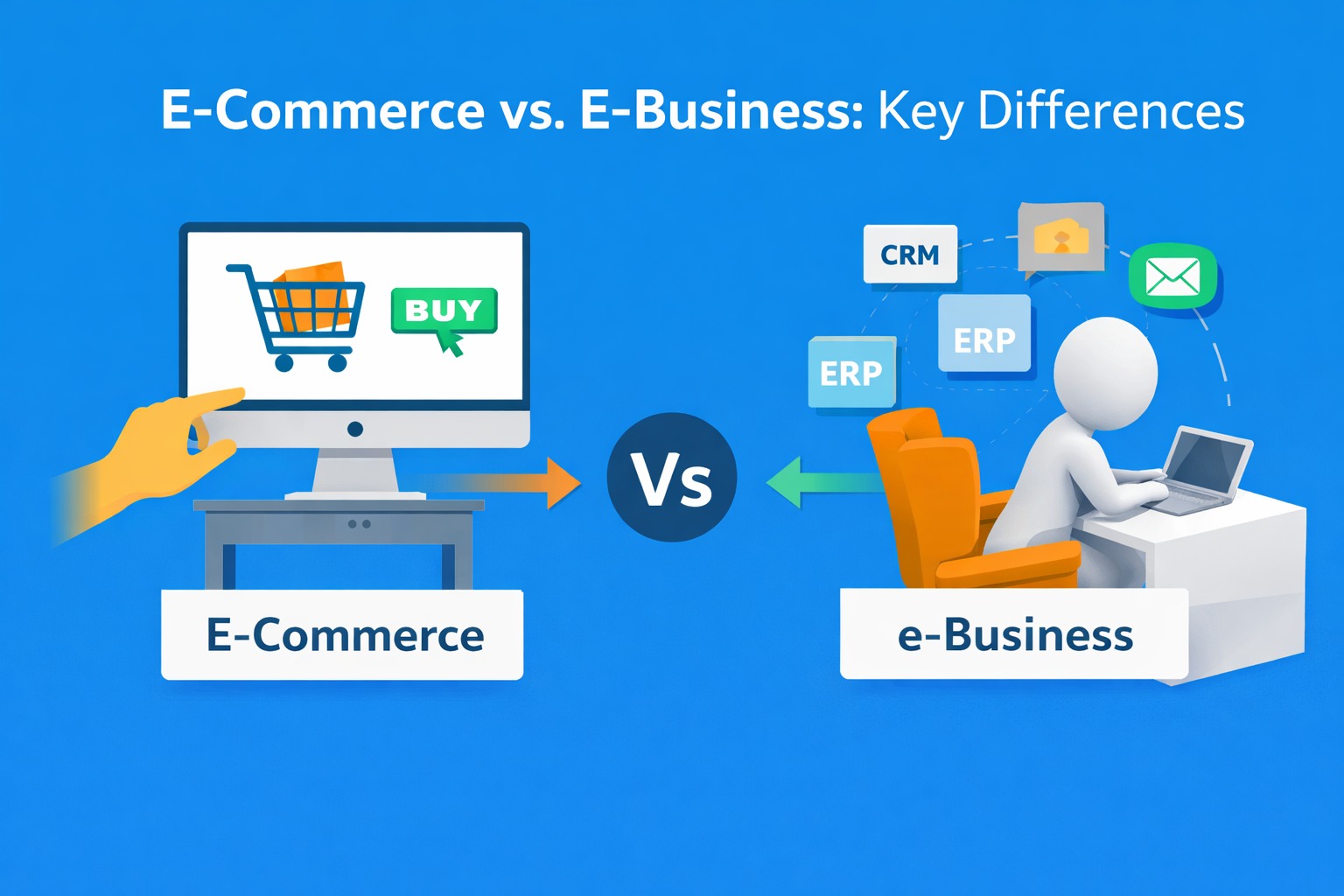
The difference between e-commerce and e-business. Over the last decade, online shopping for products and services has grown rapidly and changed the way people buy things. Today, you no longer need to visit a physical store to make a purchase. With just a few clicks, you can order almost anything from the comfort of your home.
This convenience is made possible through e-commerce and e-business, although many people mistakenly believe both terms mean the same thing when they actually have different roles. Understanding the difference between e-commerce and e-business is important for anyone looking to enter the digital market.
E-commerce (electronic commerce) refers to the process of buying, selling, and transacting goods or services over the internet. It includes activities such as placing orders, making online payments, and managing digital transactions.
One of the biggest advantages of e-commerce is that it allows businesses and customers to interact and complete purchases without any physical or face-to-face contact.
E-commerce is not limited to one format. It includes various types and models, each designed to meet different business needs and customer requirements. Some e-commerce models are simple and easy to start, while others require more planning and resources.
To better understand the difference between e commerce and e business, you should also know that e-business covers a broader scope, including online operations, customer service, marketing, and business processes beyond just buying and selling.
Types of E-Commerce Models Explained (With Examples)
- 1 Types of E-Commerce Models Explained (With Examples)
- 2 What is E-Business?
- 3 E-Commerce vs E-Business: What’s the Real Difference
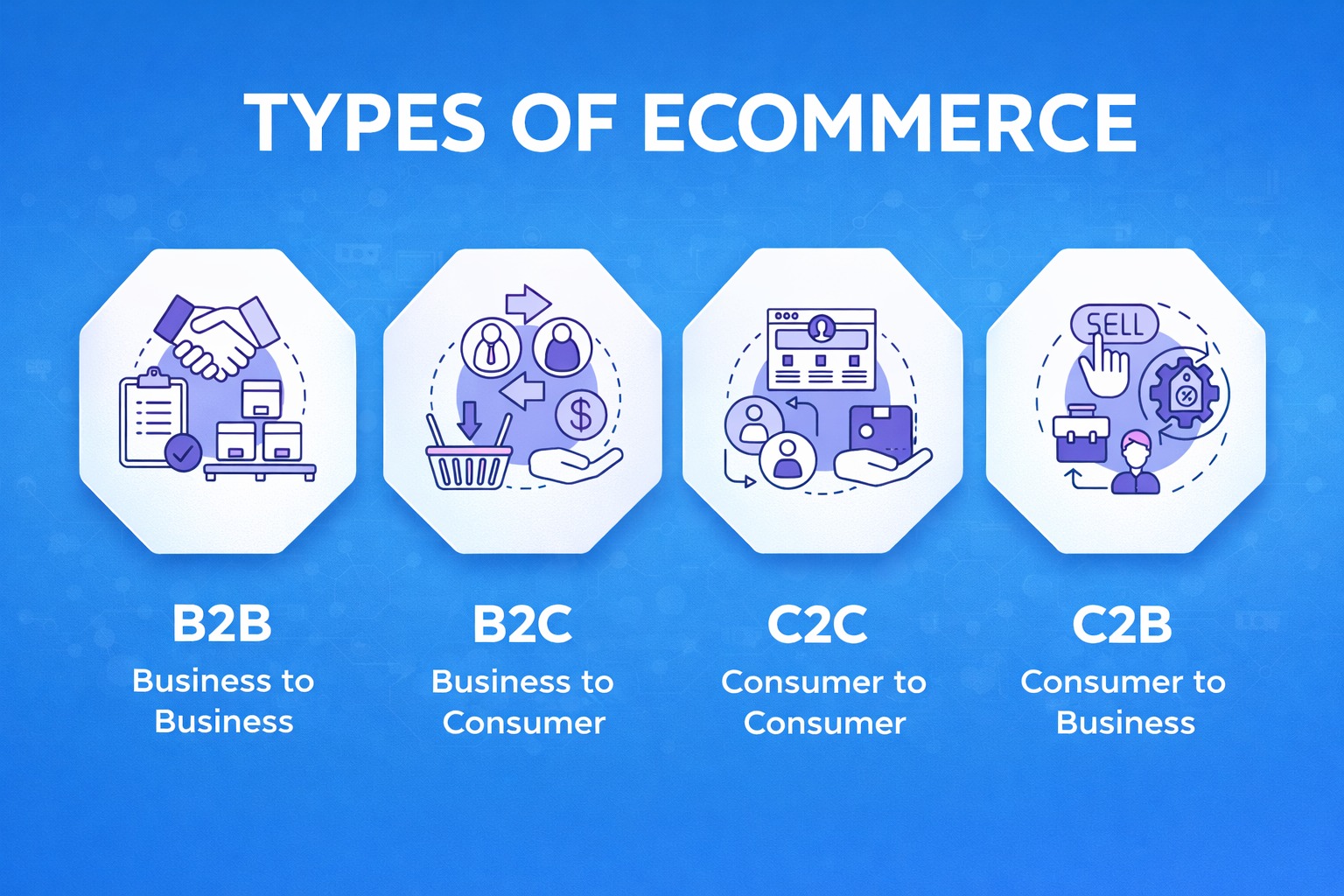
E-commerce includes different business models based on how buyers and sellers interact online. Each model serves a unique purpose and plays an important role in the digital economy. Let’s understand the major types of e-commerce in a simple and useful way:
1. Business to Business (B2B)
The B2B (Business to Business) model involves transactions where one business sells products or services to another business. These deals are usually larger in scale and often involve long-term partnerships.
A digital marketing agency offering SEO or advertising services to companies is a common B2B scenario. Similarly, manufacturers supplying goods to wholesalers or retailers also fall under this category.
Key Benefit: Strong business relationships and high-value transactions.
2. Business to Consumer (B2C)
The B2C (Business to Consumer) model is the most common type of e-commerce. In this model, businesses sell directly to individual customers through online platforms.
Today, most people prefer online shopping because it is convenient, time-saving, and easily accessible. The growth of this model increased significantly during the COVID-19 pandemic, as consumers shifted towards digital purchasing.
Key Benefit: Easy, fast, and convenient shopping experience for customers.
3. Consumer to Consumer (C2C)
The C2C (Consumer to Consumer) model allows individuals to sell products or services directly to other individuals. This usually happens through online marketplaces or reselling platforms.
People selling used items like clothes, electronics, or furniture to other users is a typical C2C transaction.
Key Benefit: Helps individuals earn money and promotes the reuse of products.
4. Consumer to Business (C2B)
The C2B (Consumer to Business) model is the reverse of traditional e-commerce. In this case, individuals offer their products or services to businesses.
A good example is freelancers or influencers who provide services like content creation, promotion, or design work to companies. With the rise of digital platforms, this model has become very popular.
Key Benefit: Creates earning opportunities for individuals and supports flexible work.
As we have a continuously revolutionizing business landscape, there are many more types of e-commerce that have been added to the list, but more or less, they are all somehow a part of the above-mentioned types. They are:
- Business to Government (B2G):
This model involves businesses supplying products or services directly to government organizations. It includes contracts, tenders, and large-scale service agreements. - Government to Business (G2B):
In this type, the government provides services, resources, or information to businesses, such as licensing, tax services, and regulatory support. - Mobile Commerce (M-Commerce):
M-Commerce refers to online transactions carried out through mobile devices like smartphones and tablets. It improves user convenience through mobile apps and optimized websites. - Social Commerce:
This model uses social media platforms to promote and sell products directly within the platform, making shopping more interactive and engaging for users. - Subscription Commerce:
In this approach, customers subscribe to receive products or services regularly, such as monthly boxes, streaming services, or recurring deliveries.
The e-commerce industry is constantly evolving with new models emerging to meet changing customer and business needs. Each type contributes significantly to how online buying and selling continue to grow and transform in the digital world.
What is E-Business?
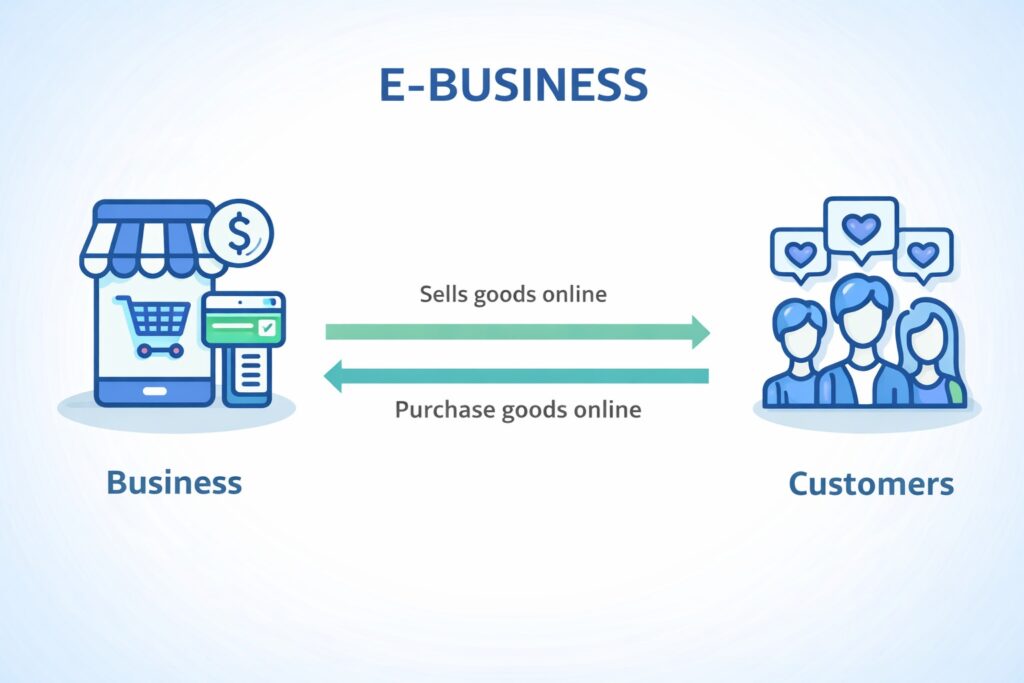
E-business (electronic business) refers to the use of the internet and digital technologies to perform and manage all business activities. It is a broad concept that includes not only buying and selling but also internal and external business operations.
In simple terms, e-business means running a business using online systems, tools, and digital platforms such as websites, applications, ERP, and CRM. It uses technologies like the internet, intranet, and extranet to improve business efficiency and communication.
Key Activities of E-Business
- Online business setup and management
- Customer communication and support
- Buying and selling processes
- Online financial transactions
- Supply chain and inventory management
- Digital marketing and email marketing
Types of E-Business
- Pure Play
- Operates mainly through online platforms
- Focuses on specific products or services
- Relies heavily on digital operations
- Bricks and Clicks
- Combines online and offline business operations
- Uses both digital platforms and physical presence
- Provides a multi-channel business approach
E-Commerce vs E-Business: What’s the Real Difference
| S. No. | E-Commerce | E-Business |
| 1 | E-commerce focuses on online buying and selling of goods and services. | E-business includes all types of business activities conducted using digital technologies. |
| 2 | It is a narrow concept and is considered a part of e-business. | E-business includes all types of business activities conducted using digital technologies. |
| 3 | It mainly deals with commercial transactions over the internet. | It covers complete business operations, including transactions and management. |
| 4 | Transactions are limited to buying and selling activities. | Transactions are not limited and include multiple business processes. |
| 5 | It includes activities like product sales and online payments. | It includes procurement, customer service, marketing, and supply chain management. |
| 6 | Usually requires a single platform like a website or app. | Requires multiple systems like CRM, ERP, and internal networks. |
| 7 | Fully dependent on the internet for operations. | Uses the internet, intranet, and extranet for different processes. |
| 8 | More suitable for business-to-consumer (B2C) models. | More suitable for Business-to-Business (B2B) and internal operations. |
| 9 | Focuses on external business activities (customer-facing). | Focuses on external business activities (customer-facing). |
Conclusion
E-commerce and e-business are closely connected but serve different purposes in the digital world. While e-commerce focuses mainly on online buying and selling, e-business covers a much wider range of activities, including business operations, customer management, and digital communication.
Understanding the difference between e-commerce and e-business helps businesses choose the right strategy for growth. If your goal is to sell products online, e-commerce is essential. However, to build a complete digital system that improves efficiency and scalability, e-business is the better approach.
As technology continues to evolve, both e-commerce and e-business will play a crucial role in shaping the future of online businesses. Adopting the right model based on your needs can help you stay competitive and grow successfully in the digital market.
Read Also: The Ultimate Guide to CopyGenius.io: How to Create High-Converting Marketing Copy with AI
FAQs
1. What is the main difference between e-commerce and e-business?
The main difference is that e-commerce is limited to online buying and selling, whereas e-business covers all digital business activities, including marketing, customer support, supply chain management, and internal operations.
2. Can a business operate without e-commerce but still be an e-business?
Yes, a business can function as an e-business without selling products online. It can use digital technologies for operations like communication, marketing, data management, and customer handling without having an e-commerce platform.
3. Which is better for beginners: e-commerce or e-business?
For beginners, e-commerce is easier to start because it focuses on selling products or services online. As the business grows, adopting e-business strategies becomes important to manage operations efficiently and scale the business.
4. What are the key benefits of e-business for companies?
E-business helps improve efficiency, reduce operational costs, enhance customer experience, and streamline business processes like inventory, communication, and marketing through digital tools.
5. Do e-commerce and e-business require the same technology?
No, e-commerce usually requires a website or app for transactions, while e-business needs advanced tools like CRM, ERP, and automation systems to manage overall business operations.
For expert insights on branding and business strategy, visit Manjeet Madhukar’s official website.